
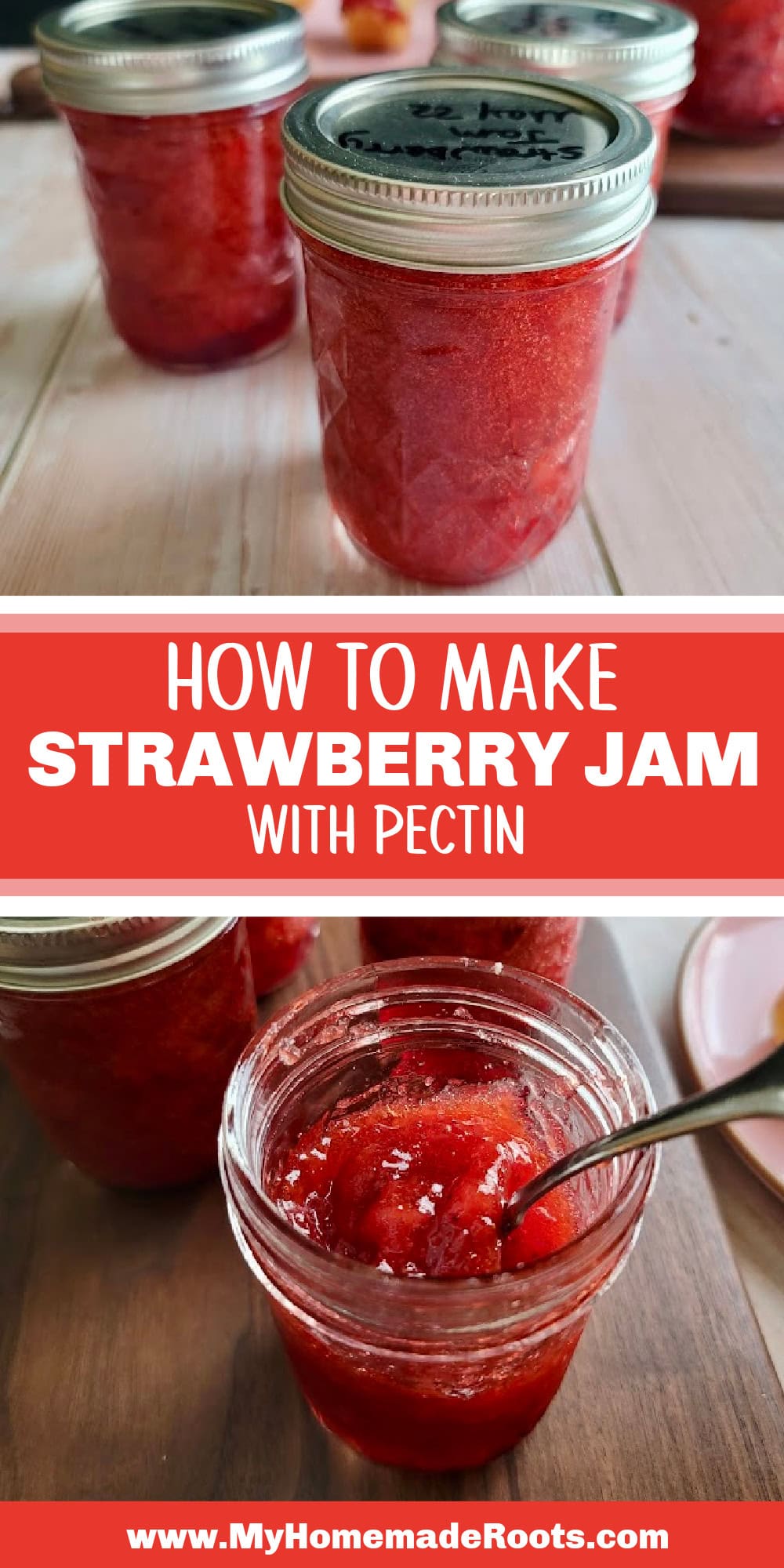
Homemade Strawberry Jam with Pectin

There’s something about a pot of strawberry jam on the stove that feels like the start of summer. The windows are open, the kitchen smells sweet and bright, and for a little while, everything slows down.
This version of strawberry jam is a little different from a store-bought jar of the classic full-sugar kind. It’s slightly softer, a bit more spoonable, and lets the fresh flavor of the berries shine through. Not stiff or overly sweet—just a gentle, homemade jam that tastes like real strawberries.
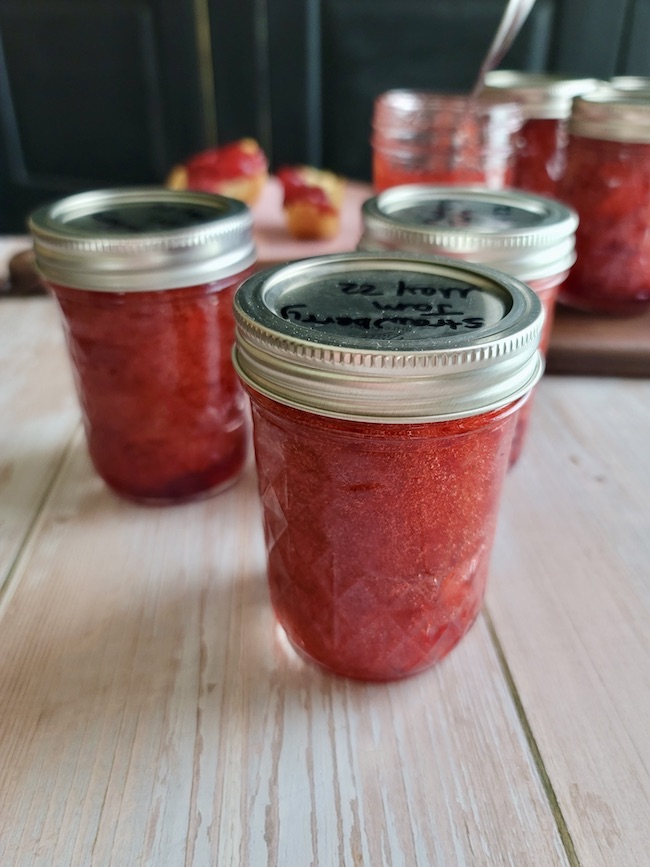
If you’ve never made jam before, don’t worry, I’ll walk you through it. And if you have, you’ll find this one to be an easy, forgiving recipe to keep in your back pocket to pull out when the berries are at their best. All you need are a few simple ingredients, a good pot, and a little patience. The rest comes together just as it should.
(And if you love to make your own jam, also check out my recipe for Blueberry Lemon Jam.)
Why I Use Pectin in This Strawberry Jam
Strawberries are delicious for jam, but they aren’t naturally high in pectin. That means they can be a little unpredictable on their own, especially in a lower-sugar recipe like this one.
Adding pectin helps the jam set more reliably without having to cook it down for a long time. It keeps the process simple, makes this recipe more beginner-friendly, and still lets that bright, fresh strawberry flavor come through.
Is this a low-sugar jam recipe?
This jam uses a bit less sugar than some traditional recipes, which lets the strawberries shine a little more. It’s not quite a low sugar jam, though. The sugar actually does important work here, helping everything set and come together just right. I’ve found this balance gives the best results.
Why This Jam Has a Softer Set
This strawberry jam is meant to be a little softer than traditional, full-sugar jams. With less sugar and a shorter cooking time, the texture stays more spoonable and closer to the natural consistency of the fruit.
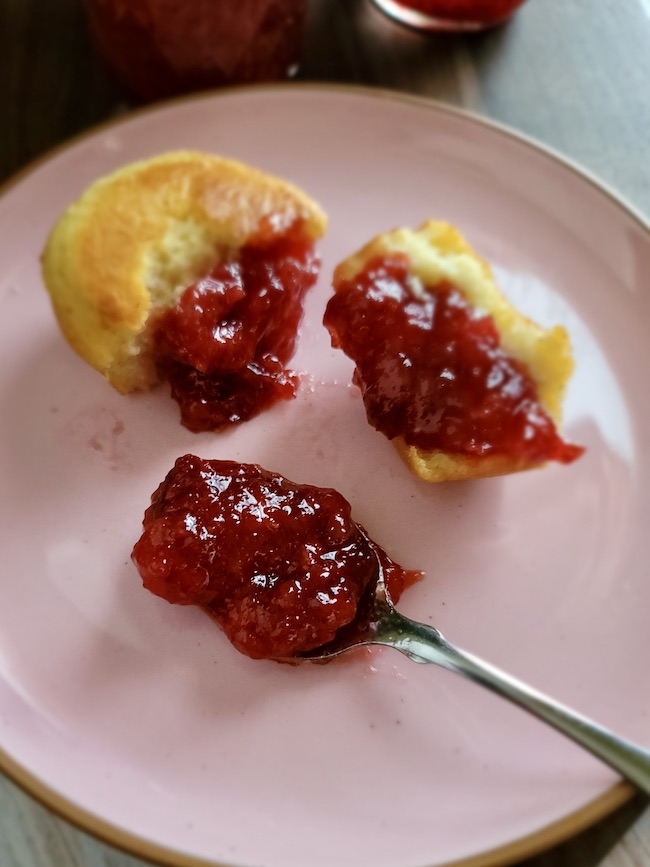
Instead of a firm, store-bought-style set, you’ll get a gentle, homemade jam that spreads easily and lets the fresh strawberry flavor shine through. It may even seem slightly loose when warm, but it will thicken as it cools—and that softer texture is part of its charm.
Ingredients for Strawberry Jam with Pectin:
🍓 A Quick Look at the Ingredients
- Strawberries: Fresh, ripe strawberries give this jam its flavor. It’s fine if a few less ripe strawberries are included, though, as they are higher in pectin and will help the jam set.
- Powdered Pectin (low or no-sugar needed): This helps the jam set without requiring as much sugar. It makes the process quicker and more reliable, especially for beginners.
- When shopping for pectin, look for a box labeled “low or no-sugar needed pectin.” It’s usually sold in small boxes or jars near the canning supplies and may be labeled for reduced-sugar or no-sugar recipes. You can also find it in bulk at some stores or on Amazon.
- Be sure to choose powdered pectin, not liquid pectin, as they are used differently and aren’t interchangeable in this recipe.
- Common brands include Sure-Jell (low or no-sugar version) and Ball RealFruit Low or No-Sugar Pectin.
- Granulated Sugar: Sugar does more than sweeten—it helps the jam thicken and preserves it. This recipe uses less than traditional jams, but still enough for a proper set.
- Lemon Juice (optional): Adds a touch of brightness to the flavor and supports the setting process. It’s not strictly required, but it rounds everything out nicely.
Tips for Making Homemade Strawberry Jam
Don’t skip this section. I’ve included helpful information and tips for making your best homemade strawberry jam.
Finishing Your Jam: What to Look For and What to Know
As your jam cooks, it will begin to thicken slightly and take on a glossy, rich look. It won’t seem very thick in the pot—and that’s perfectly normal. This is a softer-set jam, and it will continue to thicken as it cools.
How to tell if it’s ready
If you’d like a little extra reassurance, place a small spoonful on a cold plate and let it sit for a minute. Gently push it with your finger—if it scrunches up and holds its shape, it’s ready.
After cooking
Once the jam is finished, ladle it into prepared jars and process according to safe canning practices, or allow it to cool and store it in the refrigerator or freezer.
Labeling your jars
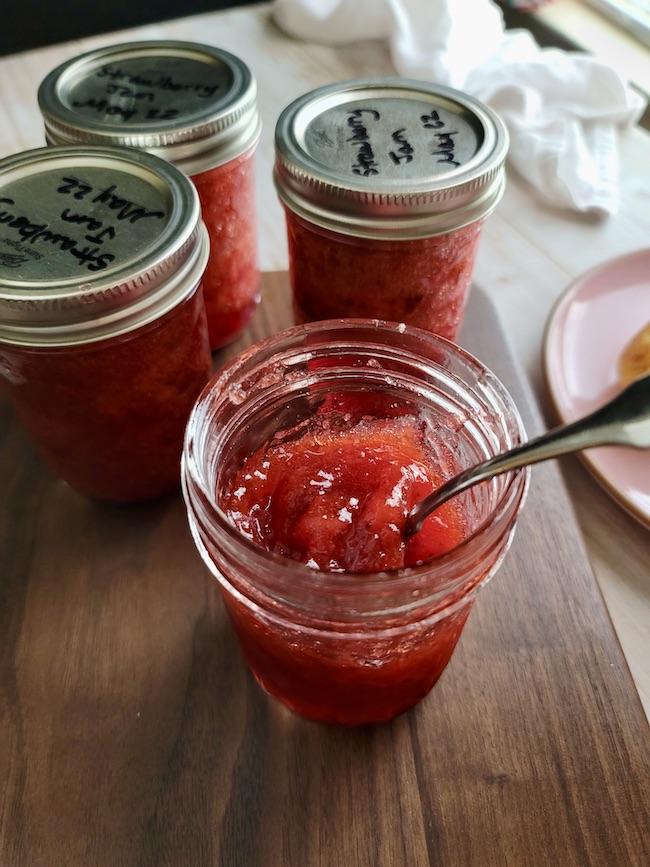
Before setting them aside, label your jars with the date and contents. It’s a small step, but one you’ll appreciate later—especially when you come across a jar months from now and can’t quite remember when you made it.
If your jam seems too soft
Strawberry jam made with less sugar will naturally have a gentler set. Give it 24 to 48 hours to fully cool and thicken before deciding if it needs any adjustments.
And when all is said and done, don’t worry too much about perfection. Some of the best jars are the ones that turn out just a little softer—easy to spoon, a bit drippy on warm toast, and full of that fresh, bright strawberry flavor that made you want to make jam in the first place.
A Little Note on Safety
Hot jam is much hotter than boiling water, and the sugar can cause serious burns if it splashes. As you cook and ladle the jam, move slowly and stir gently to avoid splattering.
Use a deep pot to give yourself plenty of room, and be careful when transferring the hot jam into jars. Taking your time here makes all the difference.
It’s a simple process, just one that’s best done with a little extra care.
🍓 Storage and Shelf Life
Once your jam has cooled, there are a few simple ways to store it, depending on how you plan to use it.
Refrigerator Storage
If you’re planning to enjoy your jam right away, you can store it in the refrigerator.
- Let the jam cool completely
- Cover and refrigerate
- Use within about 2–3 weeks
Freezer Storage
For longer storage without canning, the freezer works beautifully.
- Allow the jam to cool
- Transfer to freezer-safe containers, leaving a little room for expansion
- Freeze for up to 6 months
Thaw in the refrigerator when ready to use.
Canning for Shelf Storage
If you’d like to store your jam at room temperature, it can be preserved using a standard water bath canning method.
For clear, up-to-date guidance, I recommend following the trusted instructions from PennState Extension:
👉 https://extension.psu.edu/checklist-for-water-bath-canning
These guidelines walk you through proper jar preparation, processing times, and safe storage to ensure everything is done safely.
If you try this recipe for Easy Homemade Strawberry Jam, I hope you love it. And follow me on Facebook, Pinterest, and Instagram so you don’t miss a post.
*As an Amazon Associate I earn from qualifying purchases. This post may contain Amazon or other affiliate links, which means I will earn a commission at no additional cost to you if you click through and make a purchase.
Print
Easy Homemade Strawberry Jam (with Pectin)
- Total Time: 45 minutes
- Yield: Approximately 8 half-pints
Description
A delicious Homemade Strawberry Jam made with pectin and bursting with strawberry flavor.
Ingredients
- 6 cups crushed strawberries (buy 4 pounds, but you might have some extra)
- 1 (1.75 oz) package low or no-sugar-needed powdered pectin (about 6 tablespoons)
- 4 cups granulated sugar, divided
- 2 tablespoons lemon juice – this is mainly for flavor. You may use fresh or bottled.
Instructions
- Wash and hull the strawberries (remove the green tops), then crush them using a potato masher. You’re looking for a juicy, pulpy mixture with some small pieces remaining—not large chunks. Measure out 6 cups of crushed strawberries.
- In a large, heavy-bottomed pot, stir together the crushed strawberries, powdered pectin, ¼ cup of the measured sugar, and the lemon juice. Bring to a full rolling boil that cannot be stirred down, stirring constantly.
- Add the remaining sugar, stirring to dissolve. Return to a full rolling boil, then boil for exactly 1 minute, stirring constantly.
- Remove from heat and skim off any foam if needed.
- Ladle the jam into clean jars or freezer-safe containers.
- For refrigerator storage, ladle the jam into clean jars, allow to cool, then add lids and refrigerate for up to 2–3 weeks.
- For freezer storage, allow the jam to cool for 15 minutes, then transfer to freezer-safe containers, leaving an inch or so of headspace for expansion. Allow to cool, and freeze for up to 6 months.
- For canning, ladle the hot jam into hot, clean canning jars and process for 10 minutes using the standard water bath canning method, adjusting for altitude. (For more about canning jam, see the notes below).
Notes
Start with enough berries. You will need about 3 to 3 1/2 pounds of fresh strawberries, but it is best to start with 4 pounds to allow for trimming, discarding any bruised or spoiled fruit, and natural variation.
Remove the hulls. Be sure to hull the strawberries before crushing, as the green tops can affect both flavor and texture.
Measure the strawberries after crushing. For best results, crush first, then meassure out 6 cups of crushed strawberries.
About the pectin. This recipe uses a standard 1.75 ounce package of low or no-sugar-needed powdered pectin, such as Sure Jell or Ball RealFruit.
Using bulk pectin from a jar. If your pectin comes in a jar, measure out 1.75 ounces by weight to match one box. If you do not have a kitchen scale, this is roughly equal to about 6 tablespoons, but measuring by weight is the most accurate.
Not for two-part pectin systems. This recipe is not designed for two-part pectin systems such as Pomona, which use a different method and ratios.
Do not reduce the sugar. Even though this recipe uses less sugar than traditional jam, the amount here is important for proper setting and texture.
Give it time to set. The jam will thicken as it cools and will continue to set over 24 to 48 hours.
Learning to can. Canning is a simple process, but to do it safely, you need to learn the proper procedure. I recommend finding a good tutorial online or in a book. I recommend the Ball Complete Book of Home Preserving [affiliate link], or this Water Bath Canning Guide on the Ball website.
- Prep Time: 30 minutes
- Cook Time: 15 minutes

Hi! I’m trying out your recipe but i ended up buying powdered pectin that comes in a jar and not in the individual 1.75oz packets. Any suggestion for what that would be in tsps or TBsps? I’m finding conflicting information online.
I made your recipe. When I took them out of the canner it looks like it has been separated. Red liquid on bottom and foam and strawberries on top. Also, how long does it take to set? Thank you!
Fruit float is common, especially with strawberry jam. It’s not a big deal and doesn’t affect the safety or quality of the jam. To fix it, simply stir the jam when you open a jar and it will stay mixed up. As for how long it takes to set, typically it will set within a few hours. I have occasionally had it take up to a week to set, and on rare occasion, it doesn’t set at all. If that happens, I usually just call it syrup and use it on ice cream, pancakes, etc. I’ve included a link for more information. Hope this helps! How to Keep Strawberry Jam from Separating
Great recipe! Made it with a mix of berries and canned it with my mom. It was perfect and delicious! It really didn’t last long and we’ll be making it again!
Hi have you ever used NH pectin inside this recipe?
No, I’m sorry, I haven’t.
Thank you so much for this recipe. I searched and stressed about making this with frozen strawberries, and whether I needed to use pecton or just freeze it. In the end I chose your recipe. Using the frozen strawberries worked perfectly. I thawed them first, and then smashed them. From there it was extremely easy. I can a lot of things so the water bath part was a breeze. I’ll never use another recipe. Very grateful for you and this recipe.
I’m so happy to hear the jam turned out well!
I tried this last year. It was my first time ever making strawberry jam. It came out delicious! Everyone loved it and I can’t wait to make a bigger batch this year. Thank you for sharing this recipe!!
Followed this to a T and mine did not thicken up like jam. It’s more like a sauce
I’m sorry this happened. Sometimes it does happen when making jam. But often if you just allowed the jars to sit for a week or two, the jam will firm up. Hope this helps.
Is there a reason that this recipe calls for so much water? If the strawberries have a lot of water content, should this amount be decreased? I don’t want the jam to not set because of adding too much water. The low sugar pectin box doesn’t say anything about using water. Thank for your expertise and advice.
Hi Julie. This recipe is adapted from the 37th edition of the Ball Blue Book of Preserving in which the recipe does call for 1 cup of water. Also, I often find that store-bought strawberries are often dry and not very juicy when crushed and the extra water helps the to prevent them from scorching as they come to a boil. The added water will cook off as the jam cooks. However, I think you can probably leave out the water or reduce it, if you prefer.